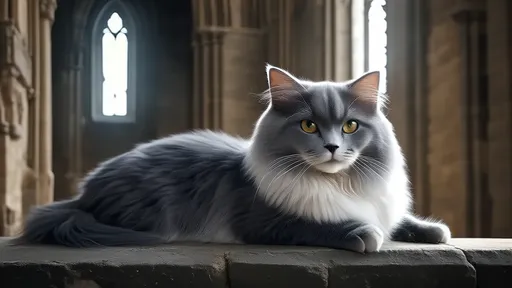
The Chartreux cat, with its striking blue-gray coat and enigmatic golden eyes, has long been shrouded in mystery. Often referred to as the "French Blue," this feline breed carries a legacy intertwined with medieval monasteries, whispered legends, and a quiet resilience that has endured centuries. Unlike many domesticated cats with well-documented lineages, the Chartreux’s origins are veiled in the kind of ambiguity that invites both scholarly debate and romantic speculation.
One persistent tale traces the breed back to the Carthusian monks of France, who allegedly kept these cats as companions in their secluded monasteries. The order, founded in 1084 by Saint Bruno, was known for its austere lifestyle and devotion to silence—a trait the Chartreux seems to mirror with its famously quiet demeanor. Yet, despite the charming narrative, historical evidence linking the cats directly to the monks remains elusive. No official records from the Carthusian monasteries mention the breed, leaving historians to wonder whether the connection is fact or a fanciful embellishment.
What is undeniable, however, is the breed’s deep-rooted presence in French culture. By the 16th century, the Chartreux had already become a fixture in rural households, prized for its hunting prowess and gentle disposition. Its dense, woolly coat—a marvel of natural adaptation—provided insulation against the harsh winters of central France, while its robust build made it an efficient mouser. Farmers and tradesmen relied on these cats not just as pets, but as indispensable protectors of grain stores and silkworm cocoons.
The breed’s near extinction during the tumultuous periods of World War I and II adds another layer to its storied past. As Europe reeled from conflict, the Chartreux population dwindled to perilous lows. It was only through the concerted efforts of dedicated breeders, particularly the Léger sisters in the 1920s, that the French Blue was pulled back from the brink. Their work on the Breton island of Belle-Île became the foundation for the modern Chartreux, ensuring the survival of a feline that had become a silent witness to centuries of human history.
Beyond its historical significance, the Chartreux captivates with its unique physical and behavioral traits. Unlike the vocal Siamese or the aloof Russian Blue, the Chartreux is a study in quiet confidence. Rarely one to demand attention, it communicates through subtle gestures—a slow blink, a gentle head butt, or the faintest of chirps. Its smile, often described as "monastic," gives the impression of a creature privy to secrets it will never divulge. This air of quiet wisdom has made the breed a muse for artists and writers, from Colette’s affectionate prose to the brushes of 18th-century portraitists who immortalized the French Blue in oil and pastel.
Today, the Chartreux remains a rare gem among cat breeds, its numbers carefully stewarded by enthusiasts who cherish its legacy. Whether it truly shared hearths with medieval monks may never be proven, but the allure of that possibility lingers. In the end, the Chartreux doesn’t need a documented pedigree to command respect. Its history is written in the quiet dignity of its presence—a living relic of France’s past, wrapped in blue-gray fur and silent mystery.
The next time you encounter a Chartreux, take a moment to appreciate the weight of its gaze. Behind those golden eyes lies a narrative that spans wars, monasteries, and the quiet corners of French countryside homes. It’s a story not of kings and conquests, but of resilience, companionship, and the unspoken bond between humans and the creatures that have shared our lives for centuries. The French Blue may never reveal all its secrets, and perhaps that’s precisely what makes it so extraordinary.

By /Jun 12, 2025
By /Jun 12, 2025
By /Jun 12, 2025
By /Jun 12, 2025

By /Jun 12, 2025
By /Jun 12, 2025

By /Jun 12, 2025

By /Jun 12, 2025
By /Jun 12, 2025
By /Jun 12, 2025

By /Jun 12, 2025
By /Jun 12, 2025

By /Jun 12, 2025
By /Jun 12, 2025
By /Jun 12, 2025
By /Jun 12, 2025
By /Jun 12, 2025
